What To Expect At A Hearing Test
Understanding Your Hearing
Several factors may contribute to hearing loss, including the natural process of aging or excessive noise exposure. Hearing loss can affect quality of life at any age. Therefore, it is vital to have your hearing checked by an audiologist if you or a significant other feels like you may be missing something in the hearing department.
If you are exposed to excessively noisy environments, consider incorporating a hearing test in your annual health care routine. This allows you to develop a hearing conservation plan to protect your hearing.
Request an Appointment

Why have your hearing tested with Musicians Hearing Solutions?
A standard hearing test measures from 250 Hertz- 8,000 Hertz, which is the extent of most natural speech sounds. At Musicians Hearing Solutions, Dr. Glick combines her intricate knowledge of sound with her audiology expertise to go further.
With her background working with professional musicians and sound engineers, Dr. Glick’s hearing test checks the full spectrum of frequencies, up to 20,000 hertz. This is rooted in her belief that testing the entire range of human hearing reveals a more intricate profile of your hearing health, allowing her to best assess your needs.
Request an Appointment


Consultation
All hearing evaluations begin with a consultation.
There are many ways to develop hearing loss, and a few questions about your health history helps determine if there is anything hereditary or genetic in your family that could be leading to hearing issues. Dr. Glick will also inquire about your history of loud sound exposure and if you have experienced tinnitus (ringing in the ears). Medical conditions such as ear infection or growths pressing on the hearing nerve can also lead to hearing loss.
Finally, Dr. Glick will explore how you experience hearing and how it affects your everyday life. She will want to understand your lifestyle, job, hobbies, and social activities to better understand how hearing factors into these different environments.
Physical examination
Following the consultation, Dr. Glick will perform a physical examination to inspect your ears, using a specialized device called an otoscope. The otoscope allows her to assess the health of your eardrum and ear canal. Dr. Glick will make sure that no debris or wax is blocking your eardrums - and if there is blockage, Dr. Glick will remove it before testing.
Request an Appointment
Diagnostic hearing tests
There are three main tests Dr. Glick will run for all patients:
Tympanometry
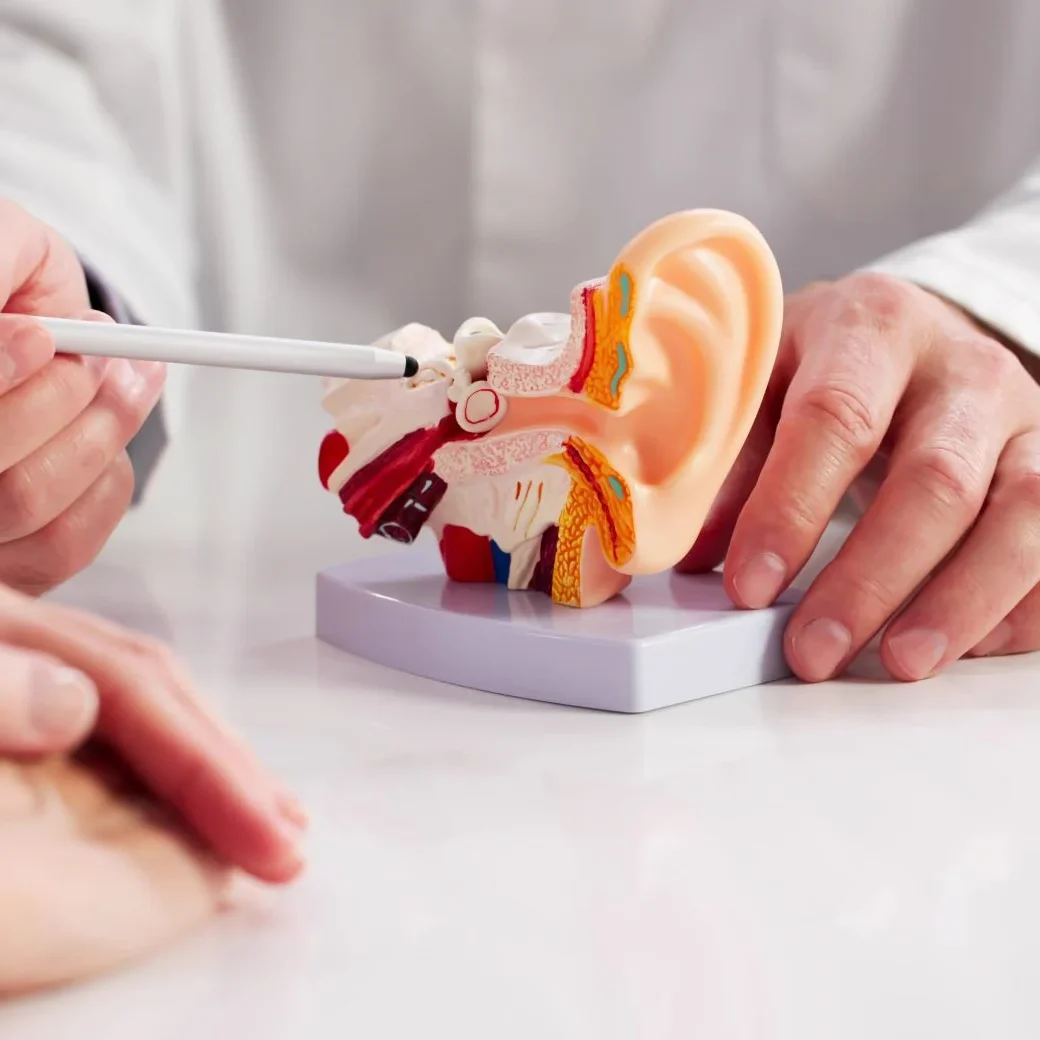
Tympanometry tests the response of the eardrum and how it moves in response to sound. For this test, Dr. Glick will place a plastic probe gently into your ear canal to identify if you have fluid in your middle ear and to examine how your eustachian tube and ossicles (the three smallest bones in your body) are functioning. All of these things, if not functioning properly, can lead to a conductive or mixed hearing loss.

Pure tone test
This test is conducted in a soundproof room. You put earphones on, attached to a computer that delivers sounds to your ears, one ear at a time. When you hear a tone, you’ll be asked to push a button. The goal of this test is to find the softest sound you are able to hear at each discrete frequency, which will create your hearing profile.

Speech test
There are two parts of the speech test. First, the speech reception test requires you to listen to and repeat a series of words at a low level. Second, the speech discrimination test assesses your ability to understand and discern speech at a comfortable listening level. This test provides us important information as to how your hearing nerve transfers sound to your brain and how your brain interprets it.
Diagnostic hearing evaluation fee is $325.00. We do not accept health insurance, but can provide you with documentation to submit to your health insurance for reimbursement if applicable.
Reviewing your audiogram
After the tests have been completed, your results will be displayed in an audiogram, showing a graphic representation which provides us with a picture of your hearing health. If a hearing loss is detected, Dr. Glick will determine the type of hearing loss (sensorineural, conductive, or mixed) and its configuration (unilateral or bilateral). Dr. Glick will also discuss the degree of hearing loss you experience.
In terms of decibels, hearing loss is defined as follows:
- Normal: less than 25 dB HL
- Mild: 25-40 dB HL
- Moderate: 41-65 dB HL
- Severe: 66-90 dB HL
- Profound: more than 90 dB HL
Looking at the audiogram, Dr. Glick can evaluate the frequencies at which deviations from normal hearing are present. This not only assists in diagnosing different types of hearing loss but also helps her find hearing aid and/or hearing protection solutions that are appropriate for your needs.
Next Steps
Following a review of your audiogram, you will be told about any preventive measures you can take, such as wearing earplugs around loud sounds, or any corrective actions you will need, such as wearing hearing aids.
Request an Appointment

What You'll Gain From a Hearing Test
Even if the results show good hearing, a hearing test is never wasted. Here's why:
- You gain an understanding of your current hearing health.
- You gain a “roadmap” which will lead to improved hearing health.
- You gain a baseline of your hearing abilities so you can track your hearing annually or as needed.
- You gain peace of mind and the courage to take the next move in your journey to better hearing.
When it comes down to it, annual hearing tests pay off. Hearing affects so many facets of your life directly - your personal relationships, your physical and mental health, and even your work. Hearing tests catch the first signs of hearing loss before it turns into a severe problem.
Schedule a consultation with us today!
Request an Appointment

Fees For Services:
• Diagnostic Hearing Evaluation: $325.00
• Ear Cleaning: $90
• Hearing Aid Evaluation: Complimentary if you are moving forward with hearing instruments. If you weren’t ready to move forward that day there is a consultation fee of $175 that would be put toward your hearing instruments when you are ready.
*** Please note we do not accept health insurance, but if your policy allows for out of network coverage we will provide you with documentation that you will need to submit for reimbursement. You can use FSA funds for these services as well. ***